
post thumbnail
Our pricing model is flexibly designed to give you the most possible advantages of a continuing partnership.

2026 Best Brushless Motor Types for Global Buyers

Choosing a brushless motor is not just a matter of comparing wattage. Global buyers must match motor type to load, speed range, control method, and operating environment. An inner-rotor design can suit compact equipment that needs high speed. An outer-rotor motor may offer useful torque in a larger diameter. Sensored models support reliable starting and precise low-speed control; sensorless versions can reduce wiring and system cost. Each has trade-offs.

Electrical-machine author John F. Gieras provides a useful engineering perspective. A practical paraphrase of his work is: “Match the motor to its operating requirements, not just its headline rating.” Treat that as a selection principle, not a verbatim quotation. For buyers, the details matter: a fan, a small pump, and a mobile machine place different demands on torque, heat, and duty cycle. Check the controller’s voltage range, mounting dimensions, cooling needs, and feedback compatibility. Then compare performance data under realistic conditions. A brochure’s peak figure may not describe continuous operation.

Look closely. Ask for test conditions. A motor that runs smoothly on a bench may behave differently in a hot enclosure or under a changing load. Supplier documentation also varies in detail, so gaps deserve questions, not assumptions. There is no universal best type. The right choice depends on the application—and sometimes the first shortlist needs revising.
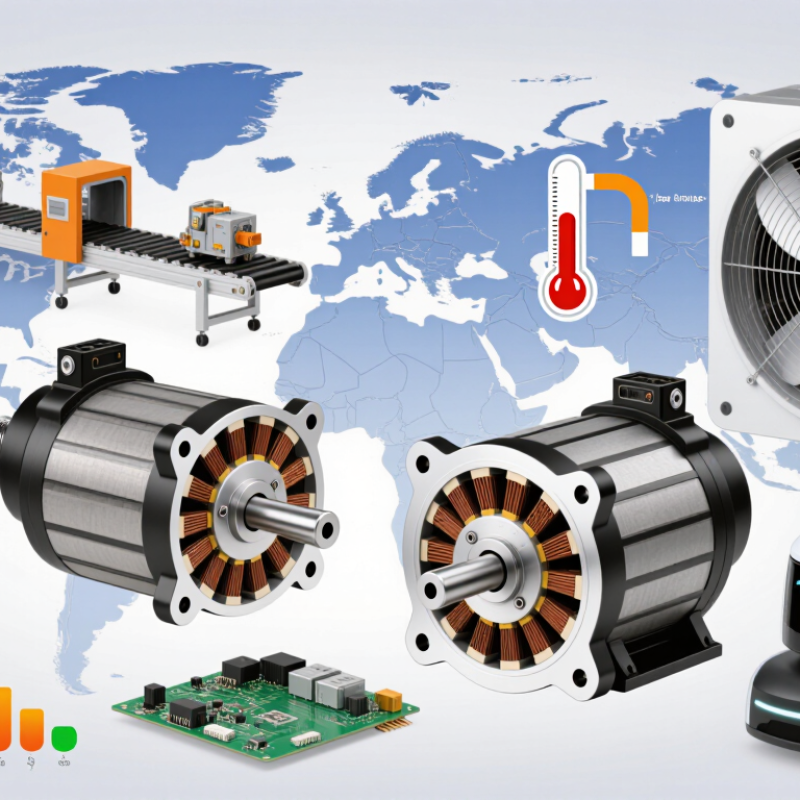
2026 Best Brushless Motor Types for Global Buyers

Brushless Motors: Definition and Core Operating Principles

Brushless Motors: Definition and Core Operating Principles

A brushless motor turns electrical energy into rotation without brushes rubbing against a commutator. Its stator holds copper windings, while permanent magnets sit on the rotor. When current passes through selected windings, it creates a magnetic field. The rotor follows that field and spins. No brush contact. This reduces a common source of wear, but it does not make every motor equally durable.

Electronic commutation replaces the mechanical switching found in brushed motors. A controller changes current between winding phases as the rotor moves. It may track rotor position with Hall sensors, or estimate it from electrical signals such as back electromotive force. The controller also adjusts current to influence torque and speed. In many systems, pulse-width modulation helps regulate the power delivered to the windings. The timing matters: poor control can cause vibration, extra heat, or uneven rotation.

For a buyer, the motor and its controller should be treated as a working pair. A compact fan may prioritize quiet, steady operation, while a powered tool may need strong starting torque. Efficiency depends on more than the motor label; load, cooling, winding design, and control settings all play a part. “Maintenance-free” sounds convenient, but bearings, insulation, and heat still deserve attention. That detail is easy to overlook.

How Brushless Motor Commutation and Control Systems Work

Brushless motors replace brushes and a mechanical commutator with an inverter that switches current through stator windings. Rotor position determines the switching sequence. Hall sensors report position directly, while sensorless drives estimate it from back-EMF after the rotor starts moving. That difference matters. At low speed or startup, back-EMF is weak, so sensorless control can struggle under load.

Many BLDC drives use six-step commutation, switching phases in discrete steps. It is simple and often cost-effective, though torque ripple can be noticeable at low speed. PMSM drives commonly use field-oriented control, which regulates phase currents more smoothly. This can improve quiet operation and low-speed precision, but requires capable electronics and careful tuning.

The International Energy Agency’s 2011 report, Energy-Efficiency Policy Opportunities for Electric Motor-Driven Systems, estimates these systems use about 45% of global electricity. Control quality therefore affects more than motor feel; it can influence system energy use.

For buyers, match the controller to the real operating cycle. Check startup torque, speed range, cooling, and sensor performance in the intended environment. A sensorless unit may suit a steady fan, yet disappoint in a loaded conveyor that starts often. A neat specification sheet can hide that mismatch. Test the motor and drive together when possible.

Major Brushless Motor Types and Their Key Characteristics

Brushless motors are commonly compared by rotor position and construction. In an inner-rotor design, the rotor sits inside the stator. This compact layout often suits higher-speed tools, pumps, and machinery. An outer-rotor motor places the rotor around the stator. Its larger radius can provide strong torque at lower speeds, which may reduce the need for gearing. Axial-flux motors use a thin, disc-like structure. They can fit space-limited designs, but cooling and sourcing options deserve careful review. Small details matter.

Control also shapes the buying decision. Sensored motors use position feedback for controlled starts and low-speed operation. Sensorless designs can reduce wiring, but may feel less smooth at very low speeds. These are control configurations, not separate rotor layouts. A buyer should compare rated voltage, continuous torque, speed range, temperature limits, and mounting dimensions against the actual load. A motor that looks powerful on a peak rating may not sustain that output in a warm, enclosed installation. There is no universally best layout; comparisons can miss real installation constraints.

Tips: Ask for a performance curve, not just a headline wattage. Check whether the stated rating is continuous, and confirm shaft size, cooling method, and feedback compatibility. If possible, test the motor with the intended controller and load.

2026 Best Brushless Motor Types for Global Buyers - Major Brushless Motor Types and Their Key Characteristics
Motor Type How It Is Classified Key Characteristics Main Advantages Trade-Offs and Buyer Checks Typical Applications
Sensored BLDC Electronic commutation with rotor-position feedback, commonly from Hall-effect sensors. Position feedback helps the controller start and operate at low speed; many conventional BLDC drives use six-step, near-trapezoidal commutation. Reliable starting under load and practical low-speed control when correctly matched to the controller. Sensors, wiring, and connectors add components. Confirm sensor type, wiring sequence, controller compatibility, and environmental protection. Pumps, appliances, small electric vehicles, and machinery that needs dependable low-speed operation.
Sensorless BLDC Rotor position is estimated from electrical signals, often using back electromotive force (back-EMF). Eliminates dedicated position sensors. Back-EMF-based methods generally need the rotor to be moving sufficiently for reliable position estimation. Fewer sensor components and wires can simplify the motor assembly and reduce potential sensor-related failure points. Starting strategy and low-speed performance depend on the controller and load. Test startup, speed range, and operation under the intended load. Fans, blowers, and other applications where sensorless operation and reduced wiring are suitable.
PMSM with sinusoidal control Permanent-magnet synchronous motor controlled with sinusoidal current, often using field-oriented control (FOC). Can provide smooth torque and precise speed control when motor, feedback system, and controller are properly configured. PMSM and BLDC terminology can vary across industries. Suitable for quiet operation, accurate control, and demanding variable-speed applications. The control system may require more setup and tuning than a basic drive. Confirm encoder or sensor requirements, control mode, and commissioning support. Robotics, precision machinery, HVAC systems, and traction drives.
Inrunner BLDC / PMSM Radial-flux construction in which the rotor is inside the stator. A common layout for compact, higher-speed motor designs; achievable speed and torque depend on the electromagnetic design and cooling. Can suit compact installations and applications that use a gearbox or other speed-reduction stage. Direct-drive torque may require a larger design or reduction gearing. Check rated speed, cooling, shaft, and mounting dimensions. Machine tools, compact drives, pumps, and geared actuators.
Outrunner BLDC / PMSM Radial-flux construction in which the rotor surrounds the stator. The larger rotor radius can support comparatively high torque at lower speeds for a given general design envelope; actual performance depends on the motor and its operating limits. Can be a useful choice for direct-drive or low-speed applications where a compact axial package is not the main priority. Consider rotor inertia, cooling, protection from dust or impact, and maximum operating speed. Compare rated torque rather than relying on motor layout alone. Direct-drive fans, wheels, gimbals, and selected electric mobility systems.
Axial-flux permanent-magnet motor Magnetic flux runs mainly parallel to the shaft axis; this describes a motor topology, not a commutation method. Often designed with a short axial length and a disc-like form. Power and torque density depend on materials, cooling, operating speed, and detailed design. Can fit applications with strict axial-space limits and may support high torque in a compact form when engineered for the duty. Thermal management, manufacturing, mechanical tolerances, and service arrangements warrant careful review. Verify continuous ratings and cooling conditions. Compact traction systems, robotics, and space-constrained direct-drive equipment.
High-speed BLDC / PMSM A speed-focused design category that can use different rotor layouts and control methods. Designed to operate at elevated rotational speeds; allowable speed depends on rotor mechanics, bearings, thermal limits, and drive settings. Can reduce the need for mechanical speed increase in applications that require high rotational speed. Confirm maximum mechanical speed, bearing life, vibration limits, rotor containment, cooling, and controller electrical-frequency capability. Spindles, compressors, turbo blowers, and high-speed process equipment.
Buyer note: These categories overlap. For example, a motor can be an outrunner and also use sensorless BLDC control. Compare rated voltage, continuous and peak torque, speed range, efficiency, cooling, protection rating, feedback, controller compatibility, and applicable local certification requirements for the complete motor-drive system.

Comparing Brushless Motor Types by Performance and Application

Brushless motors differ less by label than by control method, rotor design, and operating load. A brushless DC motor (BLDC) commonly uses trapezoidal commutation and suits compact tools, fans, and pumps needing straightforward control. A permanent-magnet synchronous motor (PMSM) typically uses sinusoidal control for smoother torque and quieter operation. That matters in a small medical pump or a conveyor moving fragile packages.

Efficiency claims need context. The International Energy Agency’s 2011 report, Energy Efficiency Policy Opportunities for Electric Motor Systems, estimates that motor-driven systems use about 45% of global electricity. That figure covers motor systems broadly, not brushless motors alone. For buyers, efficiency at the actual duty point matters more than a peak rating. Check speed range, heat rise, controller compatibility, and torque under repeated starts. A motor that looks efficient on paper may run hot in a cramped enclosure.

PMSMs often fit precision drives and variable-speed equipment, while BLDC designs can offer practical value in simpler, high-volume applications. Sensorless control may reduce wiring, but low-speed startup can become less predictable. Reluctance-based brushless designs avoid permanent magnets, though their torque ripple and acoustic behavior deserve testing. No type wins everywhere. Ask suppliers for efficiency maps and test data under your own load profile; some comparisons still feel too dependent on ideal laboratory conditions.

How Global Buyers Can Select a Brushless Motor in 2026

2026 Best Brushless Motor Types for Global Buyers

How Global Buyers Can Select a Brushless Motor in 2026

Selecting a brushless motor starts with the real load, not the catalogue headline. Record required torque, speed range, starting load, duty cycle, and available voltage. A small conveyor running continuously has different thermal needs from a fan that starts occasionally. The IEA estimates motor-driven systems use about 45% of global electricity. This figure covers motor systems broadly, not brushless motors alone. Source: IEA, Energy-Efficiency Policy Opportunities for Electric Motor-Driven Systems, 2011. It is a useful efficiency benchmark, not a brushless-market statistic.

Compare rotor design, control method, and feedback options rather than relying on labels such as BLDC or PMSM. Suppliers may use these terms differently. Ask for efficiency curves across your operating speeds, not just peak efficiency. Check winding temperature limits, ingress protection, noise, mounting dimensions, and encoder compatibility. For cross-border procurement, request test conditions and applicable safety documentation in writing. A datasheet can look complete and still omit the conditions behind its best figures.

Tips: Match the motor and drive as a system. Confirm performance at your actual voltage and load, then request a sample test. Small details matter. Leave room for uncertainty: installation, cooling, and control settings can change results. A perfect paper match may still need adjustment on the machine.

Article Source: