
post thumbnail
Our pricing model is flexibly designed to give you the most possible advantages of a continuing partnership.

How to Choose Black Rectangular Hollow Section?

Choosing a Black Rectangular Hollow Section is not just a matter of picking a size from a table. The right section must suit the load, span, connection details, finish, and conditions on site. A tube that looks substantial on a drawing may still deflect too much, complicate a joint, or add weight where it is not needed. Small choices matter.

A quick note on the expert quotation: no source articles or verified expert statement were provided, so I cannot responsibly attribute a real quotation to a named specialist. Rather than invent one, this guide uses a practical design principle: “Choose the section for the job it must do, not for appearance alone.” Treat that as editorial guidance, not a quotation from a named authority.

Start with the intended use. Is the section for a gate frame, support, furniture, or a structural assembly? Then check the outside dimensions, wall thickness, steel grade, section length, and coating requirements. Black-finished steel may need suitable surface preparation and protection, especially where moisture collects or cut edges remain exposed. Inspect the actual product documents; nominal dimensions do not tell the whole story.

Pay close attention to how loads enter the section. A connection near the end can behave differently from one placed along the face. Check fabrication tolerances, weld access, and the space available for bolts. Ask the supplier for traceable specifications, and involve a qualified engineer where structural performance matters. A neat spreadsheet helps, but it cannot replace a site check. That part is easy to overlook.
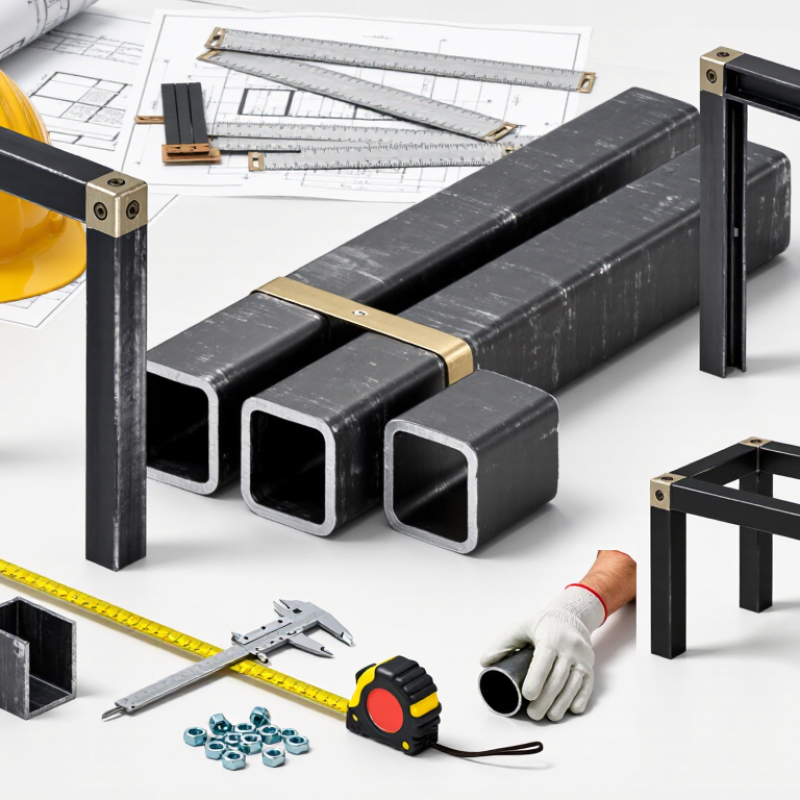
How to Choose Black Rectangular Hollow Section?

Define the Intended Use and Structural Requirements

Before choosing a black rectangular hollow section, define what it must do. Will it support a roof beam, form a gate frame, or brace a machine base? Each use creates different loads and support conditions. Start with the load. Include the weight of attached materials, expected movement, and any likely impact or vibration.

Measure the clear span and note how the section will be oriented. A rectangular tube is stiffer when its deeper side resists bending, but that does not replace proper design checks. Wall thickness matters too. A light tube may look substantial, yet still deflect or buckle under load. Check the required dimensions, steel grade, and tolerances against a structural calculation or a qualified engineer’s specification. Connections count. A strong section can still fail at a poorly designed weld or bolt joint.

Black steel may carry mill scale or another surface finish; its appearance alone does not confirm its grade or corrosion protection. For damp locations, ask what preparation and coating are needed. A common shortcut is choosing by outside dimensions only. That can be wrong. I might be tempted to pick the thickest option, but added weight and cost do not automatically solve a design problem. Verify the actual use, span, supports, and connection details before ordering.

Choose the Section Dimensions and Wall Thickness

Start with the clear span, the load, and how the section will be supported. A rectangular hollow section is specified by its outside width, outside depth, and wall thickness, such as 100 × 50 × 3 mm. Confirm which dimension will be vertical. Placing the deeper face upright usually increases bending stiffness in that direction. Looks can mislead.

Wall thickness affects more than weight. It influences strength, resistance to local buckling, weld preparation, and how well the tube tolerates dents during handling. Compare candidate sizes using section tables and calculations that account for load, span, restraint, and allowable deflection. Do not choose only by appearance. Measure the real job.

Check stated dimensions and thickness tolerances, since actual steel can vary from nominal values. In exposed or corrosive settings, discuss protection and any corrosion allowance with a qualified designer. Black finish alone does not establish grade or durability. For a gate frame, an offcut can confirm fit, but it cannot prove capacity. Include connection details, holes, and end plates in the selection review. Verify critical structural use against reliable design data.

Check Steel Grade, Finish, and Applicable Standards

Black rectangular hollow section (RHS) often arrives with mill scale, not a durable protective coating. A dry cloth can reveal loose scale; inspect corners, weld seams, and cut ends for rust or flaking. Looks simple. Check twice.

Choose the grade against design loads, wall thickness, and the governing specification. ASTM A500/A500M covers cold-formed welded and seamless carbon-steel structural tubing. EN 10219-1 sets delivery conditions for cold-formed welded hollow sections, while Part 2 addresses dimensions and tolerances. Requirements differ, so do not assume grades under separate standards are equivalent. Request a test certificate showing the grade, heat number, dimensions, and measured properties. Paperwork is easy to overlook. It matters.

For damp or outdoor service, specify a coating system rather than assuming “black” means protected. State the surface preparation, coating type, target thickness, and repair method for welds and cut edges. The 2016 NACE IMPACT study estimated corrosion costs at US$2.5 trillion, about 3.4% of global GDP, and estimated that corrosion-control practices could save 15–35%. Those broad figures are not a project forecast. Match the finish to the exposure, then verify it on delivery.

Assess Load Capacity, Durability, and Installation Conditions

A black rectangular hollow section should be selected by checking its load path, not appearance alone. Record the clear span, support locations, connection details, and expected loads before comparing sizes. For a beam, bending and deflection may govern; for a column, buckling often matters. The AISC Specification for Structural Steel Buildings (ANSI/AISC 360-22) provides design criteria, but a qualified engineer should verify the final section and connections. Do not assume the nominal wall thickness is the measured thickness.

Durability depends on coating quality, drainage, and exposure. The NACE IMPACT study estimated global corrosion costs at US$2.5 trillion annually, or 3.4% of global GDP, and identified savings through corrosion management. Black mill finish is not a protective coating. Check whether the section will face rain, road salt, trapped moisture, or contact with dissimilar metals. Installation conditions matter too: tight corners, lifting access, weld locations, and room for touch-up coating can change the practical choice. I have seen good calculations undermined by water trapped inside an unsealed tube; that detail is easy to miss.

Tips: Confirm dimensions and wall thickness on delivery. Check end caps, drainage, and coating compatibility before installation. If the site conditions are uncertain, pause and inspect again. A small delay is better than guessing.

How to Choose Black Rectangular Hollow Section? - Assess Load Capacity, Durability, and Installation Conditions

Use this guide to compare common black rectangular hollow section (RHS) sizes. Select a section based on the project design, exposure conditions, connections, and installation constraints—not on size alone.

Nominal outside size (mm) Wall thickness (mm) Indicative theoretical mass (kg/m) Load-capacity considerations Durability considerations Installation considerations Typical selection context
50 × 50 3 4.43 For relatively light-duty members; check span, end restraint, buckling, and connection strength. Uncoated black steel can rust when exposed to moisture; specify a suitable protective coating for the service environment. Lightweight and easier to handle; confirm that the wall thickness suits the planned welds or fasteners. Light frames, bracing, and small supports where design calculations confirm adequacy.
100 × 50 3 6.78 Capacity depends on which side is oriented in the direction of bending, as well as span and support conditions. Protect cut edges, welds, and any damaged coating; provide drainage where water could collect. Can be oriented with the 100 mm face in the principal bending direction; plan access for joining and coating. General framing and support members subject to project-specific verification.
100 × 50 4 8.92 The thicker wall can improve section resistance and local connection capacity, but does not establish a safe load by itself. Coating selection should reflect indoor, outdoor, or corrosive exposure; inspect enclosed or hard-to-reach areas. Heavier than the 3 mm option; check weld procedure, fastener details, and fit-up tolerances. Frames and supports requiring a thicker wall for design or connection reasons.
100 × 50 5 10.99 Assess member strength, deflection, local buckling, and load transfer through connections. Black finish is not a corrosion-resistant finish; apply a compatible protective system where required. Greater mass and wall thickness may require adjusted cutting, drilling, and welding settings. Robust framing or connection zones when justified by structural design.
150 × 100 5 18.84 A larger section can provide greater bending stiffness, but capacity still depends on orientation, length, restraints, and steel grade. Consider coating access, internal moisture control, and corrosion protection at joints and exposed ends. Plan lifting and handling; check that the section fits the site route and connection geometry. Heavier frames and supports where the design requires a larger section.
150 × 100 6 22.42 Verify the complete member and connection design, including stability and serviceability limits. Specify a coating system suitable for the exposure category and maintain it throughout the service life. Higher mass may require mechanical lifting; allow for access to welds, bolts, and inspection points. More substantial structural members, subject to engineering checks and applicable standards.

Important: Masses are indicative theoretical values calculated from nominal dimensions using a steel density of 7,850 kg/m³ and a simplified sharp-corner geometry. Actual section mass can differ because of corner radii, manufacturing tolerances, and the applicable product standard. Confirm the supplied grade, dimensions, tolerances, and certification with the supplier. A qualified structural engineer should determine design loads and verify strength, stability, deflection, connections, and installation requirements for the specific project.

Compare Suppliers, Specifications, and Product Quality

Compare suppliers on more than price. Ask each one for a written quotation showing section dimensions, wall thickness, steel grade, finish, and delivery terms. Check whether the quoted dimensions match your drawings, including corner radii and length tolerances. A dependable supplier can provide material test certificates and explain how steel batches are identified. A low quote may omit finishing or cutting costs.

Confirm whether “black” means a painted coating, a conversion finish, or simply the product’s supplied surface condition. These are not interchangeable. Compare coating details and ask how cut ends are protected, especially if the section will be exposed to moisture. Inspect a sample for even color, dents, rough weld seams, and sharp burrs. For structural use, verify grade and tolerances against the project specification rather than relying on appearance. One detail buyers sometimes miss is packaging: wet or damaged wrapping can leave marks before the steel reaches site.

Tips: Request one sample length and check it with a tape, caliper, and visual inspection. Keep the approved specification with your purchase order. If a supplier’s answer is vague, ask again; that small delay can prevent a costly mismatch.