
Natural White Oak Acoustic Slat Panel describes a decorative wall system designed to soften reflected sound while adding warmth to an interior. It usually combines narrow oak slats with a recycled PET felt backing. The felt absorbs selected frequencies, while the gaps between slats help scatter sound. It is not a soundproofing barrier. That distinction matters.
Grand View Research reports that the global acoustic panels market is projected to grow at a 7.6% compound annual growth rate from 2024 to 2030. The report reflects rising demand in offices, hospitality spaces, studios, and education buildings. Yet market growth does not guarantee acoustic performance. A panel’s result depends on its thickness, spacing, coverage area, installation method, and the room’s existing surfaces. Independent testing, especially Noise Reduction Coefficient data, deserves attention.
Trevor Cox, Professor of Acoustic Engineering at the University of Salford, has repeatedly emphasized that room acoustics concern how a space sounds, not simply how loud it is. That principle explains the appeal of a Natural White Oak Acoustic Slat Panel. It can reduce harsh reflections around a conference table, dining area, or media wall. The change may feel subtle. Often, that is the point.
Natural white oak also needs careful interpretation. Some products use real veneer. Others use printed finishes or engineered oak layers. FSC certification, formaldehyde testing, fire classification, and documented acoustic results can separate a reliable product from attractive marketing. Even expert specifications can miss occupant behavior, furniture placement, and open doors. A beautiful panel is not automatically a quiet room. The best introduction begins with evidence, then leaves room for honest measurement.
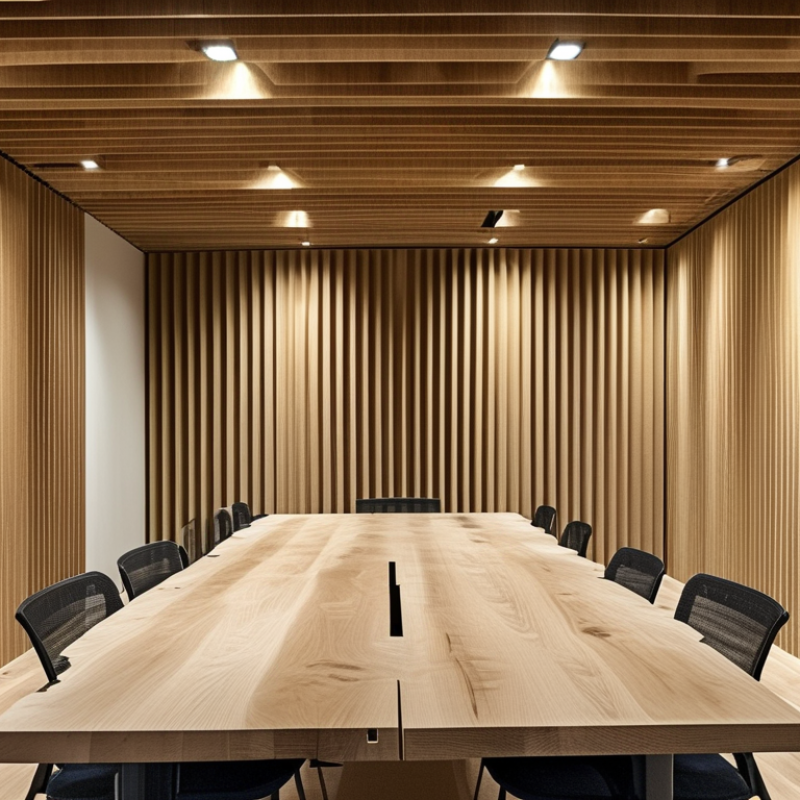
A natural white oak acoustic slat panel is a wall or ceiling treatment made from narrow oak slats fixed over an acoustic backing. The backing commonly uses felt or another sound-absorbing material. Together, these layers help reduce echoes and soften reflected noise in rooms.
Natural white oak brings pale cream tones, visible grain, and gentle variations between boards. No two panels look exactly alike. The slats add rhythm and depth, while the open gaps help sound reach the backing layer. In practical use, this can make speech feel clearer in offices, studios, dining areas, and home media rooms. Quietly practical.
Performance depends on more than the panel itself. Room size, wall coverage, mounting distance, and existing surfaces all affect acoustic results. A panel may reduce reverberation, but it does not fully block sound between rooms. Reliable specifications should include absorption test data, dimensions, backing composition, and installation guidance. Check these details before choosing a system.
White oak also requires sensible care. A dry, soft cloth usually removes surface dust. Avoid excessive moisture, harsh cleaners, and direct heat. Natural wood may change slightly with sunlight and humidity, which is part of its character but not always convenient. I would also verify the finish, indoor air information, and fire-rating documentation for the intended space. The word “natural” sounds reassuring, yet it does not explain every material layer.
Natural white oak acoustic slat panels combine a real wood veneer, a stable core, and an absorptive backing layer. The visible veneer provides oak’s pale grain, small knots, and warm variation. The core usually uses MDF or another engineered wood board. It reduces movement compared with solid oak. That matters in changing indoor humidity.
The slats are fixed to a dark acoustic felt panel, often made from recycled polyester fibers. Narrow gaps between slats allow sound energy to reach the felt. The backing then converts part of that energy into low-level heat. Wider gaps can improve absorption, but they also reduce the wood surface. Construction always involves compromise.
Laboratory performance should be checked under ISO 354 or ASTM C423. These standards measure sound absorption in reverberation rooms. Tested systems often achieve noise reduction coefficients near 0.70 to 0.95, depending on spacing, cavity depth, and installation. Results vary considerably. A wall-mounted panel cannot perform like a ceiling cloud.
The World Health Organization’s Environmental Noise Guidelines for the European Region recommends less than 30 dB(A) indoors at night for good sleep conditions. A panel alone cannot guarantee that target. Room size, glazing, ventilation, and background noise still matter. Installers should also review fire classification, formaldehyde emissions, and fixing strength. Natural oak is not perfectly uniform. That is part of its character, but it requires honest specification and quality control.
What Is a Natural White Oak Acoustic Slat Panel?
How Natural White Oak Acoustic Slat Panels Improve Room Acoustics
A natural white oak acoustic slat panel combines timber slats, felt backing, and an absorptive cavity. The oak adds warmth, grain variation, and visual rhythm. The felt absorbs part of the sound energy entering between the slats. The remaining surface scatters reflections across walls and ceilings. This helps reduce harsh echoes in offices, dining rooms, studios, and meeting spaces.
The improvement depends on the whole wall system. ASTM C423 measures sound absorption in reverberation rooms and reports values through absorption coefficients and NRC ratings. A panel with open spacing and a deeper cavity usually absorbs more mid-frequency sound than a tightly mounted panel. That range matters for speech clarity. The World Health Organization recommends indoor classroom noise below 35 dB LAeq during teaching periods. Slat panels cannot achieve that target alone, but they can reduce reverberant buildup.
A practical installation should address the ceiling, floor, windows, and opposite walls. Otherwise, sound may continue bouncing across untreated surfaces. In a small meeting room, voices can feel clearer after treatment, especially around 500 to 2,000 Hz. Measurements using ISO 3382 methods can confirm reverberation-time changes. Samples can mislead. A beautiful panel may perform poorly when installed without an air gap or acoustic backing. That limitation deserves attention. Performance should be checked from tested data, not appearance alone.
Natural white oak slats provide the visible wood finish, while the open spacing and acoustic backing help absorb reflected sound. The representative octave-band values below show how a slatted wood panel system can outperform a hard gypsum wall, especially at mid and high frequencies.
Data basis: representative, non-brand-specific laboratory-style absorption values for a wood slat panel system installed over porous acoustic backing. Actual performance varies with slat width, spacing, backing thickness, installation, and room conditions.
What Is a Natural White Oak Acoustic Slat Panel?
A natural white oak acoustic slat panel combines wooden slats with an absorptive backing. It softens echoes while adding warmth, texture, and visual rhythm to an interior. The oak surface may show small variations in grain and color. These differences are normal, not defects.
Before installation, inspect the wall for moisture, dust, and uneven areas. Allow the panels to acclimate indoors for several days. This helps reduce movement after fitting. That step is easy to skip. On a flat, dry wall, use appropriate adhesive with screws fixed into studs or suitable anchors. Mechanical fixing provides better long-term security. For masonry walls, select fasteners designed for the substrate. Leave a small perimeter gap where the manufacturer’s guidance recommends it. Wood can expand slightly with seasonal humidity changes.
Placement strongly affects acoustic results. Install panels opposite hard surfaces, such as glass, painted walls, or polished flooring. Behind a desk, dining table, or seating area, they can reduce distracting reflections. Full-height placement often creates a stronger visual effect, while a partial wall can control cost and improve access to sockets. Avoid covering ventilation grilles, radiators, or electrical equipment. These panels reduce reflected sound; they do not fully soundproof a room. I have seen installations look excellent but perform poorly because the wall was too reflective elsewhere. Alignment also deserves patience. A small mismatch can remain visible, so recheck every joint before tightening the final fixings.
What Is a Natural White Oak Acoustic Slat Panel?
A natural white oak acoustic slat panel combines timber slats with an absorptive backing. Its pale grain suits offices, studios, restaurants, bedrooms, and media rooms. The slats scatter some reflections, while the backing absorbs part of the sound energy. They reduce echo, not every noise. A panel cannot stop footsteps from an upper floor.
Common uses include open-plan workspaces, meeting rooms, music areas, and hospitality interiors. The right quantity depends on room volume, wall coverage, ceiling height, and furniture. ASTM C423 evaluates sound absorption in a laboratory, often reporting the Noise Reduction Coefficient across 250, 500, 1,000, and 2,000 Hz. Treat that number carefully. Real rooms perform differently. The World Health Organization recommends indoor night noise below 30 dB(A) for bedrooms and below 35 dB(A) in classrooms (WHO, 2018). Slat panels alone cannot guarantee those levels.
Maintenance is simple but not careless. Remove dust with a soft vacuum brush or dry microfiber cloth. Wipe spills quickly with a barely damp cloth. Avoid soaking the felt backing. Direct sunlight may deepen or unevenly change oak’s color. Keep humidity reasonably stable, since timber responds to moisture. Installation also matters: an air gap behind the panel can improve low-frequency absorption, while tightly mounting it may reduce performance. I would request a tested report for the exact assembly, not just the timber species. Natural grain varies, and one panel can look slightly different from another. That is attractive, but it requires honest specification.
Common uses, maintenance requirements, and key performance factors
| Category | Factor or Feature | Typical Information | Practical Guidance |
|---|---|---|---|
| Material | Natural white oak finish | White oak is a hardwood with a visible grain pattern and a warm, light-to-medium brown appearance. “Natural” usually indicates that the wood character remains visible rather than being covered by an opaque color. | Expect variation in grain, tone, knots, and shade between panels. Samples should be reviewed before installation. |
| Construction | Slat-and-absorber design | Most acoustic slat panels combine narrow wood slats with a dark acoustic backing, commonly made from a porous fiber or felt-like material. The spacing between slats allows sound energy to reach the absorber. | Confirm the core material, slat spacing, panel thickness, and mounting method in the product specifications. |
| Common Use | Home offices and study rooms | The panels can reduce reflected sound from hard walls and help create a calmer environment for calls, reading, and focused work. | Treat the wall behind a desk or the primary reflection area first. They do not replace soundproofing between rooms. |
| Common Use | Meeting rooms and conference areas | Wall-mounted panels can help improve speech clarity by reducing excessive reverberation from large, reflective surfaces. | Combine wall treatment with a suitable ceiling, floor, or furnishing strategy when the room has strong echo. |
| Common Use | Restaurants, cafés, and hospitality spaces | White oak slat panels provide a decorative wood appearance while helping manage noise created by conversations, dishes, and hard flooring. | Select a surface finish and installation system that can withstand the expected cleaning frequency and traffic level. |
| Common Use | Living rooms and media rooms | Panels may reduce wall reflections around televisions and speakers, supporting a more controlled listening environment. | Use alongside soft furnishings such as rugs, curtains, and upholstered furniture for more balanced room acoustics. |
| Acoustic Performance | Sound absorption | Performance depends on the absorber behind the slats, the open area between slats, panel thickness, installation method, and the air gap behind the panel. | Look for laboratory-tested absorption data, such as sound absorption coefficients or a weighted absorption rating, rather than relying only on appearance. |
| Acoustic Performance | Frequency range | Thin panels are generally more effective at controlling mid- and high-frequency reflections. Low-frequency control usually requires greater thickness, a deeper air cavity, or additional bass treatment. | For music rooms or spaces with strong bass buildup, plan a broader acoustic treatment strategy. |
| Acoustic Performance | Reverberation and speech clarity | Reducing repeated reflections can lower perceived echo and improve speech intelligibility. The overall result depends on the amount and placement of treatment in the room. | Prioritize large untreated walls and the first-reflection zones near speaking or listening positions. |
| Installation | Wall preparation | The mounting surface should be structurally sound, reasonably flat, clean, and dry. Uneven walls may require battens, shims, or another leveling method. | Locate electrical wiring and plumbing before drilling or fastening panels. |
| Installation | Air gap behind the panel | A small cavity between the panel and wall can increase the effective depth of the absorber and may improve lower-frequency absorption compared with direct mounting. | Use the tested installation configuration whenever acoustic ratings are important. |
| Maintenance | Routine cleaning | Remove dust with a soft, dry microfiber cloth, soft brush, or vacuum cleaner fitted with a brush attachment. Clean in the direction of the wood grain when possible. | Clean gently and avoid pressing debris into the acoustic backing. |
| Maintenance | Spill and stain treatment | Wipe liquid spills promptly with a clean, lightly damp cloth, then dry the surface. Standing moisture can stain wood and affect the backing material. | Test any approved cleaner on an inconspicuous area first. Do not saturate the panel. |
| Maintenance | Humidity and temperature | Wood naturally expands and contracts as indoor humidity changes. Excessive moisture or rapid environmental changes can contribute to movement, gaps, or warping. | Use the panels in stable indoor conditions and avoid direct exposure to leaks, steam, or persistent condensation. |
| Limitations | Soundproofing | Acoustic slat panels primarily absorb reflected sound inside a room. They generally do not provide substantial blocking of sound traveling through walls, ceilings, doors, or windows. | For sound isolation, consider mass, airtight construction, decoupling, and specialist acoustic design. |
| Safety | Fire performance | Fire behavior depends on the wood finish, backing, adhesives, substrate, and complete installation assembly. A decorative wood appearance does not indicate a specific fire rating. | Request tested fire-classification documentation when panels are intended for commercial, public, or code-regulated interiors. |
| Selection | Key specifications to compare | Important specifications include panel dimensions, total thickness, slat width and spacing, backing type, acoustic test results, fire classification, finish, installation method, and environmental limitations. | Compare complete technical data rather than judging performance from color, slat density, or visual texture alone. |
Note: Acoustic results vary with room size, ceiling height, wall coverage, furniture, mounting method, and product construction. Always use the manufacturer’s technical documentation and tested installation details for project-specific decisions.