
Selecting a machine safety door is not a cosmetic choice. It affects how operators access equipment, how hazards are contained, and how production resumes after a stop. The scale of workplace risk is significant: the International Labour Organization’s 2023 report, A Call for Safer and Healthier Working Environments, estimates 2.93 million work-related deaths and 395 million non-fatal work injuries worldwide each year. These figures cover all industries, not machine-door incidents alone, but they show why practical safeguards deserve careful evaluation.
Small details matter. A door that binds, a poorly positioned interlock, or a difficult reset can undermine an otherwise sound installation. Safety scientist Sidney Dekker’s often-cited observation, “Safety is not the absence of accidents; it is the presence of defenses,” offers a useful lens for assessing these products. It is a broad safety principle, not a product endorsement. ISO 14119:2013 provides guidance on interlocking devices associated with guards, while OSHA’s machine-guarding requirements, including 29 CFR 1910.212, address protection from machine hazards. Buyers should verify how each manufacturer documents its designs and supports installation.
This guide introduces China’s top 10 Machine Safety Door manufacturers and the practical factors behind a shortlist: construction, access design, interlock compatibility, customization, and after-sales support. Rankings can simplify research, but they cannot replace site-specific risk assessment or direct supplier checks. A polished catalog is not proof of performance. The comparison may also miss details that only appear during installation; that limitation is worth remembering.
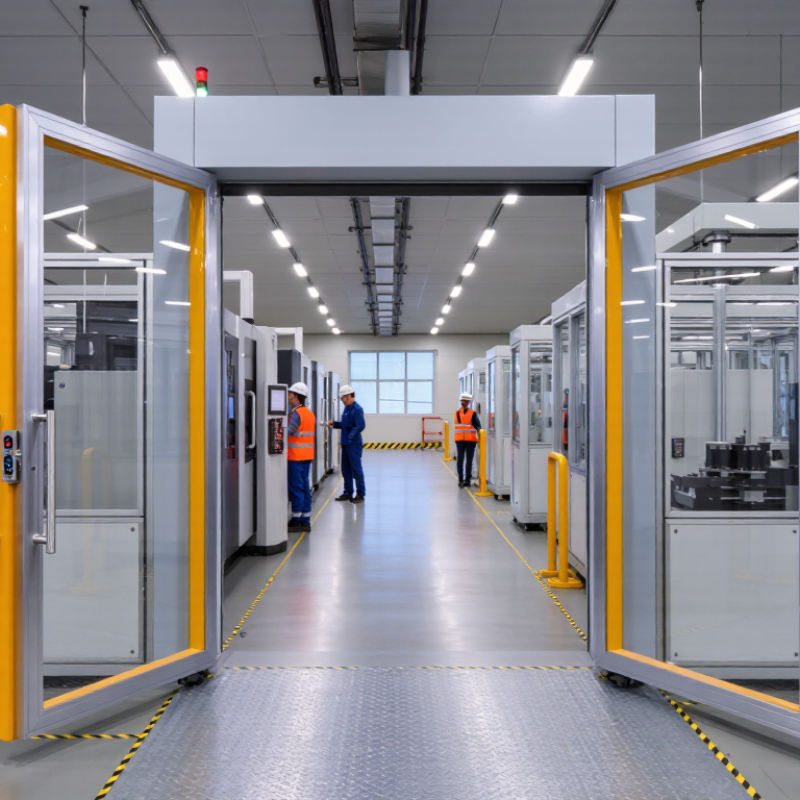
Machine safety doors help separate people from moving equipment while keeping production areas accessible. Common types include hinged doors for compact cells, sliding doors for wide openings, and vertical doors where floor space is limited. Transparent panels can improve visibility, but they must withstand likely impacts and remain easy to inspect. Core technologies include coded interlocks, guard-locking devices, and safety-rated position sensors. These components can prevent a machine from running when a door is open, or keep it stopped until hazardous motion ends. The right setup depends on access frequency, machine stopping time, and the space around the work area. A door that looks sturdy may still create a reach-through gap.
Tips: Check hinges, latches, sensor alignment, and panel condition during routine inspections. Test the stopping sequence after maintenance. Small misalignment matters.
Selection should consider how operators actually use the doorway. A frequently accessed station may need a fast, low-effort door, while a large automated cell may require a powered sliding system with monitored locking. Flexible safety controls can support different operating modes, but configuration errors can weaken protection. Keep wiring protected from abrasion, coolant, and repeated movement. Record test results and repair defects promptly. One detail is easy to overlook: a well-designed door can still be inconvenient if carts block its travel path. Map that path before installation, then review it with the people who use the cell each shift.
China’s machine safety door manufacturing landscape serves factories that need practical guarding around presses, conveyors, and automated cells. Manufacturers typically work with steel frames, mesh panels, polycarbonate windows, hinges, and interlocking devices. The right combination depends on the machine’s movement, access frequency, and cleaning needs. A sliding door may suit a narrow aisle, while a hinged panel needs enough swing clearance. Details matter. A strong frame can still cause trouble if its latch is hard to reach or its opening conflicts with nearby equipment.
Tips: Share machine drawings, opening dimensions, and operating conditions before requesting a quote. Ask how the door and interlock will be checked after installation. Confirm replacement-part availability, too. A low price means little if a damaged hinge delays maintenance.
When comparing suppliers, review material specifications, fabrication tolerances, and inspection records—not just photographs. Ask for clear drawings showing mounting points and access gaps. Test the door on the actual machine where possible; a neat drawing can hide awkward reach or poor visibility. Supplier capabilities vary, and a polished sample does not guarantee a consistent production run. That deserves a second look. Teams should also agree on who verifies fit, alignment, and interlock function before the equipment enters service.
China Top 10 Machine Safety Door Manufacturers
Criteria for Evaluating Machine Safety Door Manufacturers
Choosing a machine safety door manufacturer requires more than comparing prices. Check whether the supplier can explain how its door design fits your machine’s hazards, operating speed, and maintenance routine. A sliding door for a compact CNC cell may need different safeguards from a large automated line. Ask for drawings, material specifications, and documented test results. Clear evidence matters.
Examine the complete safety system, not just the door panel. Ask how interlocks behave during opening, whether the door can withstand expected impacts, and how stopping time was assessed. Request references for installations with similar operating conditions. Confirm that documentation is available in a language your engineers can use. A polished brochure is not proof. One detail can be overlooked: replacement parts and service response times often affect long-term reliability.
Tips: Request a sample inspection checklist and review it with your maintenance team. Verify certificates with the issuing organization, and ask how design changes are recorded. Check door alignment, hinges, seals, and fasteners during a site visit. If a supplier avoids specific answers, pause and investigate further. Even a strong product may need adjustment to suit your floor layout.
| No. | Evaluation Criterion | Weight | What to Evaluate | Evidence to Request |
|---|---|---|---|---|
| 1 | Risk Assessment and Safety Design | 15% | Whether the door and guard design addresses access to hazards, foreseeable misuse, opening direction, reach-through risks, and safe maintenance access. | Risk-assessment records, machine layout drawings, and documented design rationale. |
| 2 | Guard Construction and Durability | 13% | Frame and panel strength, resistance to expected impact and operating conditions, secure fixings, corrosion protection, and suitability for the working environment. | Material specifications, structural details, test records where applicable, and maintenance guidance. |
| 3 | Interlocking and Guard-Locking Options | 12% | Availability of suitable interlocking devices and, where residual risk requires it, guard locking that prevents access until hazardous motion has stopped. | Device specifications, wiring or integration diagrams, and information on applicable ISO 14119 requirements. |
| 4 | Safety-Related Control Integration | 12% | Whether safety functions can be integrated and validated in the machine control system at the required performance level or safety integrity level. | Safety-function descriptions, component data, validation documentation, and relevant ISO 13849-1 or IEC 62061 design information. |
| 5 | Standards and Compliance Documentation | 10% | Clarity and completeness of technical documentation supporting the intended application; certification claims should be checked for scope and validity. | Declarations or certificates where applicable, test reports, technical files, and references to relevant guarding standards such as ISO 14120. |
| 6 | Customization and Application Fit | 10% | Ability to accommodate required openings, machine geometry, access frequency, visibility, contamination, temperature, and installation constraints. | Approved drawings, dimensional tolerances, configuration options, and documented review of application requirements. |
| 7 | Manufacturing Quality Controls | 9% | Repeatability of fabrication and assembly, inspection of critical dimensions, traceability of components, and control of nonconforming products. | Quality procedures, inspection plans, sample inspection records, and traceability examples. |
| 8 | Installation and Maintenance Support | 7% | Availability of clear installation instructions, adjustment procedures, replacement parts, and maintenance intervals for the door and safety devices. | Installation manuals, maintenance instructions, spare-parts information, and service response terms. |
| 9 | Lead Time and Delivery Reliability | 6% | Ability to provide realistic production and delivery schedules, communicate changes, and protect products during shipment. | Written lead-time estimates, delivery records for comparable orders, packaging specifications, and escalation procedures. |
| 10 | Commercial Clarity and Lifecycle Cost | 6% | Transparency of scope, pricing, warranty conditions, exclusions, replacement costs, and expected maintenance requirements over the product lifecycle. | Itemized quotation, warranty terms, agreed scope of supply, and lifecycle or maintenance cost assumptions. |
| Total Evaluation Weight | 100% | Apply the same evidence-based scoring method to each supplier. This framework is for comparison and does not represent a verified ranking of specific manufacturers. | ||
Suggested scoring: Rate each criterion from 1 to 5 (1 = insufficient evidence or poor fit; 3 = meets stated requirements; 5 = strong, documented performance). Calculate the weighted score as the rating divided by 5, multiplied by the criterion weight. Confirm that the final door and safety system are appropriate for the machine-specific risk assessment and applicable local requirements.
Profiles of China’s top ten machine safety door manufacturers are most useful when they compare practical capabilities, not just product photos. One manufacturer may specialize in modular sliding doors for compact cells. Another may focus on large hinged guards for maintenance access. Others may offer interlocked panels, transparent viewing windows, or custom frames for unusual equipment layouts. These differences matter on the factory floor. A door that clears a narrow aisle can save space, while a clear panel helps operators inspect a process without opening the guard. Small details count.
A reliable profile should explain how a manufacturer handles dimensions, materials, installation, and replacement parts. Ask whether drawings are checked against the machine layout and whether hinges or tracks can withstand repeated use. Look for specific details, such as frame thickness, panel options, and how the door aligns after installation. A polished catalog is not proof of dependable performance. Neither is a low price. It can be difficult to compare suppliers when specifications are incomplete, and even a careful profile may leave questions unanswered. That deserves attention. Buyers should verify technical claims and request drawings for their own application before making a decision.
Reference values from ISO 13857 for the minimum distance between a regular slot opening and a hazard zone.
Opening ranges are shown in millimetres. Distances are minimum values; apply the relevant standard edition and complete a machine-specific risk assessment when designing guards.
When comparing China’s top 10 machine safety door manufacturers, examine how each design performs on the production floor. Options may include hinged or sliding guards, coded interlocks, guard locking, emergency release, and status diagnostics. Ask for endurance-test results, cycle-life data, and drawings showing clearance around robots or machine tools. Small details matter. A door that binds under dust or vibration can disrupt a shift.
Certification claims need careful review. ISO 14119 addresses interlocking devices associated with guards, while ISO 13849-1 provides a framework for assessing safety-related control systems. These are standards, not product certificates. Request the exact certificate scope, issuing body, and validation records; confirm that the supplied configuration matches tested components. The International Federation of Robotics reported 541,302 industrial robot installations worldwide in 2023, with 4,281,585 robots in operation. That scale, reported in World Robotics 2024, makes reliable access control relevant to robot cells, automotive lines, packaging equipment, and machining centers.
Compare application evidence, not just catalogue features. Useful checks include opening force, escape-release access, resistance to coolant or metal dust, and compatibility with the machine’s safety circuit. One gap is easy to miss: a well-rated interlock cannot compensate for poor installation or bypass-prone workflow. Site trials help. Ask manufacturers for risk-assessment support and maintenance instructions, then verify them against actual operating conditions.