post thumbnail
Our pricing model is flexibly designed to give you the most possible advantages of a continuing partnership.

China Top 10 CNC Machine Fabrication Companies?

China’s CNC machine fabrication sector has moved beyond low-cost production. It now includes high-speed machining centers, five-axis systems, turning centers, and automated production cells. Buyers must examine more than catalog prices. Spindle accuracy, thermal stability, controller support, and service response can determine factory performance.

The International Federation of Robotics reported 541,302 industrial robots were installed worldwide in 2023. That figure shows how automation is reshaping machine-tool demand. Deloitte’s 2024 smart manufacturing research also found that many manufacturers expect connected production to strengthen competitiveness within five years. However, these reports measure broad manufacturing trends, not every Chinese machine builder. Market estimates also vary widely. That uncertainty deserves attention.

Manufacturing researcher Dr. David Dornfeld repeatedly emphasized a practical principle: “You cannot improve what you cannot measure.” It applies directly to CNC machine fabrication. A credible supplier should provide positioning-accuracy data, repeatability results, component specifications, and documented factory testing. Buyers should also inspect installation records and after-sales coverage. A polished showroom proves little.

This guide examines ten leading Chinese companies through those practical criteria. It considers product range, engineering capability, export experience, automation readiness, certifications, and customer support. The ranking is not absolute. A heavy-duty aerospace supplier may not suit a small workshop producing aluminum parts. Real performance depends on application, maintenance, programming, and operator skill. The best choice is therefore not always the largest company. It is the supplier whose machine remains accurate beside a warm factory window, during long production runs, with help available when problems appear.
China Top 10 CNC Machine Fabrication Companies?

What Defines a Leading CNC Machine Fabrication Company in China

A leading CNC machine fabrication company in China is defined by engineering discipline, not factory size alone. Its machines should hold stable tolerances across long production runs, with rigid castings, accurate linear systems, and thermal compensation. According to the International Federation of Robotics’ World Robotics 2024 report, China installed 276,288 industrial robots in 2023, representing 51% of global installations. This automation scale raises expectations for CNC builders. Integration with robots, probing systems, and production software now matters.

Quality evidence must be visible. A serious manufacturer provides material certificates, calibration records, spindle test results, and dimensional inspection reports. ISO 9001 certification helps, but it does not replace machine-level proof. Buyers should examine repeatability data under realistic workloads, not only showroom demonstrations. Tool life, vibration, coolant control, and power consumption deserve attention. Small details expose large weaknesses.

After-sales capability also separates a leading supplier from an ordinary fabricator. China’s export-oriented manufacturing base demands multilingual documentation, remote diagnostics, spare-parts planning, and trained service engineers. The International Trade Centre’s Trade Map data shows China remains a major exporter across machinery categories, yet export volume alone cannot prove technical reliability. No supplier is flawless. A missed tolerance or delayed software update can reveal process gaps. The best companies acknowledge these risks, record corrective actions, and improve their designs instead of hiding inconvenient results.

Criteria for Ranking China’s Top CNC Machine Fabrication Companies

China’s top CNC machine fabrication companies should be ranked by verified capability, not advertising volume. The China Machine Tool Industry Association reports sustained demand for high-end manufacturing equipment, while the International Federation of Robotics recorded 276,288 robot installations in China during 2023. This industrial depth matters, but it does not automatically prove machining quality.

A practical ranking should examine positioning accuracy, repeatability, thermal stability, and five-axis interpolation. Auditors should review ISO 230-2 test results, laser calibration records, and ballbar reports.

A machine cutting aluminum may show different behavior from one cutting hardened steel. Buyers should also inspect spindle runout, granite or cast-iron structures, chip evacuation, and vibration control under real workloads.

Numbers matter.
Evidence matters more.

Company scores should include ISO 9001 procedures, component traceability, operator training, spare-parts availability, and response times after installation. The 2024 World Robotics report also highlights China’s growing automation ecosystem, making software integration and robotic loading useful ranking factors.

Export experience, electrical documentation, safety compliance, and acceptance testing deserve measurable points. Customer references should be contacted directly, preferably at operating factories.

No scorecard is perfect. Published accuracy can weaken after years of heat, dust, and rushed maintenance, so independent site visits remain essential.

Profiles of the Top 10 Chinese CNC Machine Fabrication Companies

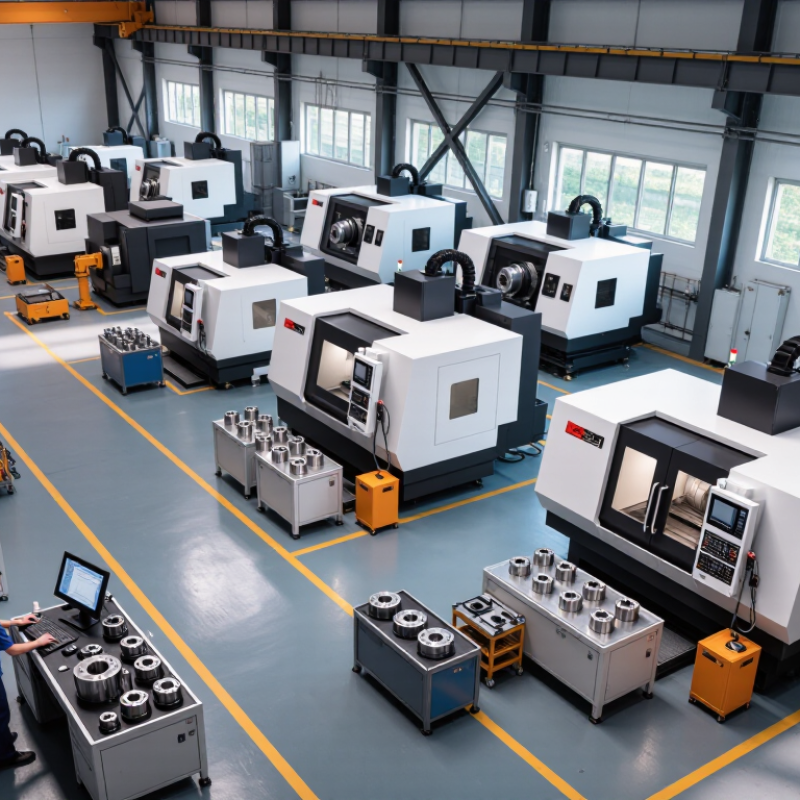
China’s leading CNC machine fabrication companies serve different manufacturing needs. One focuses on high-speed machining centers for aluminum parts and aerospace tooling. Another builds heavy-duty vertical lathes for energy and construction components. A third specializes in compact turning centers for automotive suppliers. Their workshops commonly include laser interferometers, coordinate measuring machines, and climate-controlled inspection areas.

Several other manufacturers stand out through practical specialization. One produces five-axis systems for complex medical and mold components. Another develops large gantry machines with reinforced beds for oversized parts. A precision-focused company supplies Swiss-type turning equipment for small shafts, connectors, and precision fasteners. One factory combines CNC fabrication with automation, using robotic loading and pallet-changing systems. This reduces idle time, but setup quality still matters.

The remaining profiles include a builder of economical three-axis mills for training centers and small workshops. Another concentrates on customized machines, adapting spindle power, table size, and control functions to unusual production lines. The tenth company emphasizes service, spare-part availability, operator training, and remote diagnostics. Those details often decide long-term value. Rankings can change with export records, testing data, and customer feedback. A polished brochure is not proof. Buyers should inspect sample cuts, verify positioning accuracy, review maintenance response times, and request references from comparable users. Some factories look impressive, yet their software integration remains weak. That deserves honest attention.

China's Top 10 CNC Machine Fabrication Companies: Technical Capability Benchmarks

This neutral benchmark compares typical achievable tolerance levels across major CNC machine categories commonly represented in China's high-end machine-tool sector. Lower values indicate finer machining capability; actual performance depends on machine configuration, materials, tooling, calibration, and operating conditions.

Reference basis: commonly published industrial specification ranges and ISO 230-2 measurement terminology. Values are representative technical benchmarks rather than individual company claims.

Comparison of CNC Technologies, Industries, and Production Capabilities

China’s top ten CNC machine fabrication companies should be compared by technology, not name recognition alone. A practical review examines three-axis, five-axis, turning, milling, and mill-turn systems. Five-axis equipment can machine curved aerospace parts with fewer setups. Turning centers suit shafts, rings, and high-volume components. Hybrid machines may combine cutting and additive processes, but their maintenance demands are higher.

Industry needs differ sharply. Automotive production values cycle time, repeatability, and automated loading. Aerospace workshops require tight tolerances, traceable inspection, and stable machining of titanium or aluminum. Medical manufacturers often prioritize clean production, fine surface finishes, and documented quality control. Electronics suppliers may need compact machines for small, precise parts. Production capability also depends on spindle speed, work envelope, controller functions, tooling access, and after-sales engineering support. A large machine is not automatically better. That assumption deserves review.

Tips: Ask for sample parts, tolerance records, cycle-time data, and inspection reports. Check whether the factory can support prototypes, small batches, or continuous production. Visit the workshop if possible. Observe chip control, coolant management, operator training, and measurement equipment. A supplier may advertise impressive accuracy, yet real performance can vary with material, tooling, and operator experience. Comparing these details creates a more reliable ranking than catalog specifications alone. My assessment would remain cautious without independent testing.

Key Factors for Choosing a Chinese CNC Machine Fabrication Partner

Choosing among China’s top 10 CNC machine fabrication companies requires more than comparing prices. Global CNC machine demand remains strong; Grand View Research estimated the market at about USD 83.9 billion in 2023, with continued growth expected through 2030. This pressure can encourage fast quotations, but speed is not production capability.

Check the supplier’s machining range, tolerance control, and inspection system. Ask for recent sample reports showing dimensional results, surface roughness, and material certificates. A reliable partner should explain its equipment, calibration schedule, and corrective-action process clearly. ISO 9001 certification supports process consistency, but it does not replace an on-site audit. Look for traceability from raw material receipt to final packing. Small details matter.

Request a pilot order before approving full production. Measure critical features independently, especially holes, threads, flatness, and concentricity. Interact Analysis has reported continued automation investment in Asian manufacturing, yet automation alone cannot guarantee stable output. Operators still influence setup quality and response time. I would also review communication habits, engineering change control, and packaging tests. A perfect presentation can hide weak documentation. No supplier gets every detail right. The better question is how quickly and honestly the team corrects a mistake. Use comparable quotations, not the lowest quotation, and record every technical assumption in the purchase agreement.