


Top CNC Steel Grades for Precision Machining
Choosing the right cnc steel grade is a practical decision with real consequences. It affects tool life, dimensional stability, surface finish, and the cost of each part. The scale of steel production is vast: World Steel Association’s World Steel in Figures 2024 reports 1,892.2 million tonnes of crude steel produced worldwide in 2023. That figure describes the industry, not machining suitability. Grade selection still depends on the part, process, and required properties.
For precision machining, common choices include 1018 and 1045 carbon steels, 4140 alloy steel, and free-machining 12L14. Each behaves differently at the cutting edge. For example, 12L14 can machine quickly, while its lead content makes it unsuitable for some applications. Heat treatment, bar condition, and tool setup can also change results. A grade chart alone can mislead. Small details matter.
ASTM specifications help define material requirements, while ASM International’s Metals Handbook offers deeper technical guidance on steel properties and machining. Neither replaces checking the actual mill certificate or testing a production cut. That distinction is easy to overlook. This guide compares leading steel grades by machinability, strength, finish potential, and typical use, while noting their trade-offs. There is no universal winner; even a familiar grade can disappoint when the part’s geometry or tolerances are unforgiving.
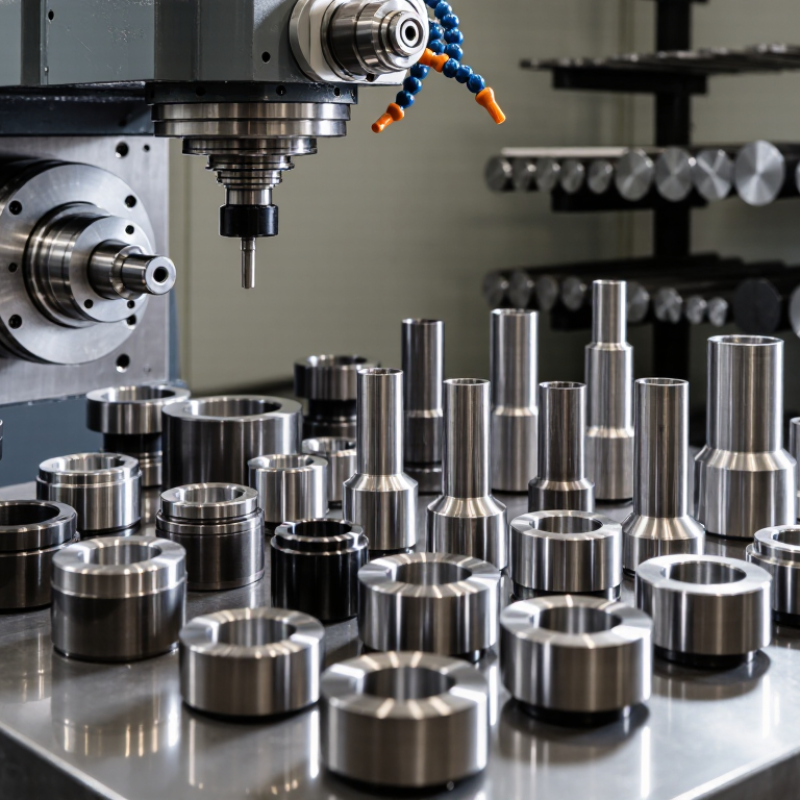
Steel Selection Metrics: Compare Machinability Against the AISI B1112 = 100 Baseline
Top CNC Steel Grades for Precision Machining
Steel Selection Metrics: Compare Machinability Against the AISI B1112 = 100 Baseline
AISI B1112 provides a useful reference point: its machinability rating is set at 100. Other grades are compared with that baseline, but published ratings can vary by testing method and supplier. AISI 12L14 often rates well above 100, making it attractive for high-volume turning and crisp surface finishes. AISI 1215 is another free-machining option, while 1144 and 1045 generally trade some cutting ease for different strength or service requirements. The number is a guide, not a promise.
For precision work, compare the rating with the actual operation. A bar that cuts easily in turning may behave differently during drilling, threading, or interrupted cuts. Consider chip shape, tool wear, surface finish, and the part’s load requirements together. A high score can reduce cycle time, but it does not automatically make a grade the best fit. This is where selection gets less tidy.
Tips: Check that machinability figures use the same B1112 = 100 scale before comparing them. Run a short trial on the intended machine, using the planned tool and coolant. Record cutting speed, chip control, and finish; even then, results may need adjustment.
Top CNC Steel Grades for Precision Machining — Machinability Compared with AISI B1112 = 100
| Steel Grade | Typical Stock Condition | Approx. Machinability Index | Relative to B1112 | Machining Characteristics | Common CNC Uses |
|---|---|---|---|---|---|
| AISI 12L14 | Cold-drawn, resulfurized and leaded | About 160 | About 1.60× | Produces short, easily broken chips and supports high cutting speeds; lead content may restrict use in some applications. | High-volume turned fittings, fasteners, and small precision components where leaded material is permitted. |
| AISI 1212 | Cold-drawn, resulfurized | About 136 | About 1.36× | Free-machining low-carbon steel with good chip breaking; sulfur can reduce transverse ductility and weldability. | Screws, pins, bushings, and general-purpose turned parts. |
| AISI 1215 | Cold-drawn, resulfurized and rephosphorized | About 136 | About 1.36× | Designed for efficient machining and consistent chip control; not generally selected for demanding welding or forming. | Automatic-screw-machine parts, spacers, and precision shafts. |
| AISI 416 | Annealed, free-machining martensitic stainless steel | About 110 | About 1.10× | Machines more readily than common 300-series stainless grades; offers magnetic response and can be heat treated. | Valves, pump components, instrument parts, and corrosion-resistant turned components. |
| AISI B1112 | Resulfurized free-machining carbon steel | 100 (baseline) | 1.00× | Reference grade for this comparison; intended for good machinability in automatic machining operations. | Small turned parts, screws, and general free-machining components. |
| AISI 1144 | Cold-drawn, medium-carbon resulfurized steel | About 83 | About 0.83× | Combines improved machinability with higher strength than low-carbon free-machining grades; sulfur may affect weldability. | Spindles, shafts, studs, and components requiring strength with efficient machining. |
| AISI 303 | Annealed, austenitic stainless steel | About 78 | About 0.78× | Sulfur improves chip breaking compared with 304, while corrosion resistance and weldability are generally lower than 304. | Stainless fasteners, fittings, shafts, and machined components in mildly corrosive environments. |
| AISI 1018 | Cold-drawn low-carbon steel | About 78 | About 0.78× | Good general-purpose formability and weldability; typically produces longer chips than free-machining grades. | Fixtures, pins, couplings, and general-purpose machined parts. |
| AISI 4140 | Annealed alloy steel | About 65 | About 0.65× | Offers good strength and hardenability; machining effort increases substantially in hardened conditions. | Gears, shafts, tooling components, and parts requiring heat treatment or higher strength. |
| AISI 1045 | Normalized or cold-drawn medium-carbon steel | About 55 | About 0.55× | Provides greater strength and wear resistance than low-carbon grades, with moderate machinability. | Axles, shafts, gears, and machine components subject to moderate loads. |
| AISI 304 | Annealed, austenitic stainless steel | About 45 | About 0.45× | Good general corrosion resistance, but work hardening and heat generation require appropriate tooling and cutting practice. | Food-processing, chemical-service, and corrosion-resistant components. |
Machinability indices are approximate, commonly published comparative values normalized to AISI B1112 = 100. Actual results vary with material condition, supplier, tooling, machine rigidity, and cutting parameters. Confirm the required grade, condition, and applicable specifications before production.
Related Posts
-
What Are the Top 10 CNC Steel Suppliers Worldwide?
-
Top CNC Machines in China for Global Buyers Needs?
-
2026 Best High Precision Machining Companies?
-
2026 How to Choose a Precision CNC Milling Machine?
-
2025 Top 5 High Precision Machining Trends and Technologies Revolutionizing Manufacturing
-
2025 Top 10 5 Axis CNC Machines Revolutionizing Precision Manufacturing